
Critical Infrastructure in the News
By Ernie Hayden MIPM, GICSP(Gold), PSP, CISSP (Retired)
Do you know what critical infrastructure really is? Recent newscasts highlight impacts: Hawaii’s devastating March 2026 floods from Kona Low storms caused $1 billion in damage, threatening dams and roads. In the Middle East, strikes hit Iranian and other infrastructure amid escalating war fears.
Every morning and evening, news programs are full of discussions about the impacts on “critical infrastructure.” After the recent massive flooding in Hawaii, there were widespread concerns about critical infrastructure damage and destruction. Also, with the highly active war in the Middle East, the news casts are busy describing the attacks and counterattacks on critical infrastructure.
But do you really know what “critical infrastructure” constitutes?
Critical infrastructure surrounds us. We use it every day. It keeps our factories running, schools operating, and governments governing. It is also especially important for a nation’s functioning.
A favorite quote about infrastructure is from an article in The Atlantic where the author, Ian Bogost, observed:
Infrastructure is everything you don’t think about. The roads you drive on. The rigs and refineries that turn fossil fuel into the gas that makes your car go. The electricity that powers the streetlights and lamps that guide your way. All these technologies vanish into the oblivion of normalcy.
A government-based definition of “critical infrastructure” surfaced during the Clinton administration around 1998. There, critical infrastructure was defined as “…those physical and cyber-based systems essential to the minimum operations of the economy and government.”
Later, in the Patriot Act (Post 9/11) a definition of critical infrastructure arose:
Critical infrastructure means systems and assets, whether physical or virtual, so vital to the United States that the incapacity or destruction of such systems and assets would have a debilitating impact on security, national economic security, national public health or safety, or any combination of those matters.
Other countries have also made the effort to define critical infrastructure. The United Kingdom has its own definition, riding on the concept of “…assets and facilities, systems, networks, or processes, and the essential workers that operate and facilitate them.” Canada weaves in similar processes, systems, etc. “…essential to the health, safety, and security or economic well-being of Canadians.” Similar themes are used by New Zealand, Australia, the European Union, Germany, Japan, and the Netherlands.
So, what actions should you take? First, read – no, study – this book. Secondly, pick one of your critical systems, such as cooling water, air conditioning, or even part of your supply chain. Then walk through the system to identify vulnerabilities and weaknesses. Build an action plan to repair the weaknesses, then move to your next critical system. Even doing one critical system a month is a great start.
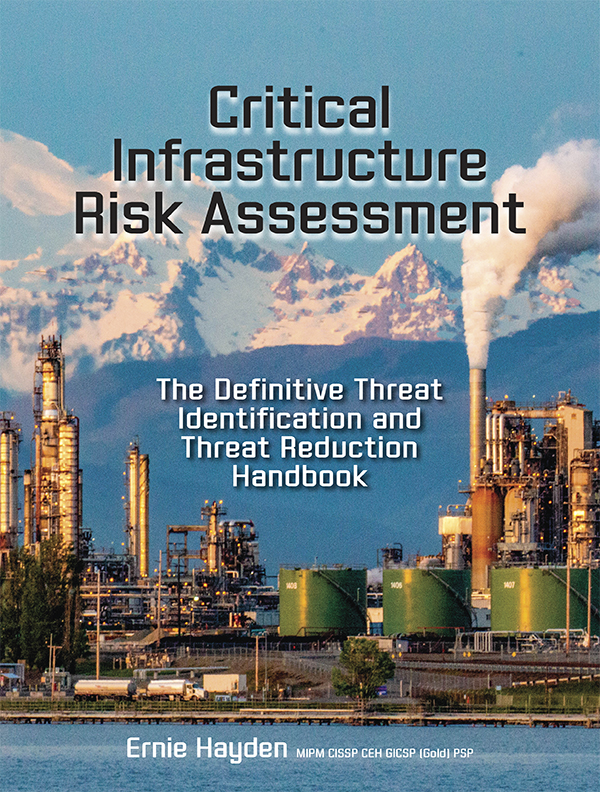
Ernie Hayden MIPM, GICSP(Gold), PSP, CISSP (Retired) is the author of the ASIS INTERNATIONAL BOOK OF THE YEAR: Critical Infrastructure Risk Assessment: The Definitive Threat Identification and Threat Reduction Handbook.
 Click here to learn more about Critical Infrastructure
Risk Assessment
Get your free chapter — “The Power of the Observation”
- An overview of the concept of an “observation.”
- The primary elements included in the observation, as well as its format.
- Fundamental considerations when performing and documenting the observation, including the power of one’s influence on the actions being observed, the need for critical thinking, and considerations on how the observation supports the risk assessment.
Click HERE to receive your free chapter!
Book Available from Amazon – click here
ePub or PDF eBook – click here
#criticalinfrastructure #riskassessment #erniehayden #threat identification
