Description
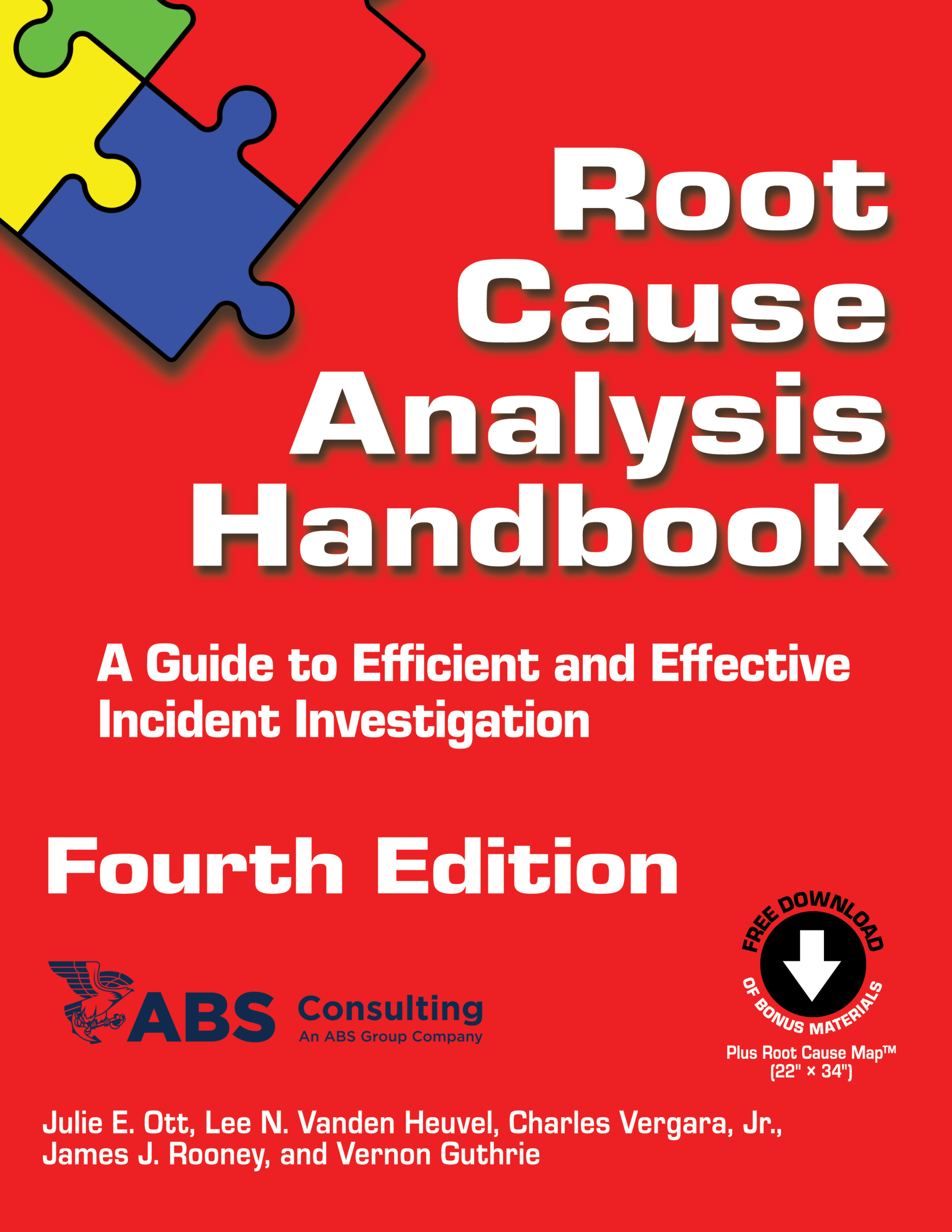
Unlock the power of ROOT CAUSE ANALYSIS with the NEW 4th Edition of the Root Cause Analysis Handbook with its downloadable resources and 22″x34″ RCA Map™ − the gold standard in root cause analysis (RCA)
NOW AVAILABLE!
The Root Cause Analysis Handbook offers the unique breadth, depth, and practicality that can only come from five authors with a wellspring of 150+ years of combined consulting experience in the fields of risk/reliability engineering, risk management, incident investigation/root cause analysis, human factors, hazard analysis, process safety, environmental safety, loss prevention, asset integrity, and professional/ technical training.
Are you ready to transform your approach to incident investigation and risk management?
The Root Cause Analysis Handbook is your essential guide, backed by over 150 years of combined expertise from five seasoned authors. This comprehensive resource combines real-world experience with a proven methodology, making it the gold standard in root cause analysis (RCA).
Why This Handbook is a Must-Have:
- Expert Insights: Learn from professionals with extensive backgrounds in risk/reliability engineering, incident investigation, process safety, human factors, and more. Their hands-on experience ensures you receive practical, applicable knowledge.
- Global Best Practices: Benefit from methodologies developed by an international consulting firm with 50+ years of success across 35+ countries. This book presents field-tested strategies tailored for various industries, NGOs, and government agencies.
- Practical Toolkit: The accompanying 300+ page downloadable toolkit includes:
- Cause and Effect Trees: Easily adaptable templates for thorough analysis.
- Sample Plans: Step-by-step guides for effective investigation.
- Forms and Checklists: Streamline your processes with ready-to-use resources.
- Exclusive Access: Enjoy ongoing support with licensed access to ABS Consulting’s website, featuring a wealth of articles, charts, and tools to keep you informed and effective in your RCA efforts.
Comprehensive Learning Experience:
This 700+-page package offers a deep dive into the SOURCE methodology—Seeking Out the Underlying Causes of Events—enabling you to uncover the root causes of incidents and implement effective corrective actions.
- Step-by-Step Guidance: Navigate each phase of RCA, from initiating investigations to reporting and trending findings.
- Visual Tools: Utilize the Root Cause Map™, a vibrant 22″ x 34″ wall chart that simplifies the coding and identification of root causes.
- Detailed Appendices: Enhance your understanding with four comprehensive appendices covering glossaries, causal factor charts, timelines, and more.
Who Should Read This Book?
- Professionals in Quality, Reliability, and Safety: If you’re responsible for managing risk or ensuring safety in your organization, this handbook is essential for your toolkit.
- Students and Educators: Perfect for classroom use, this resource supports learning in college courses and professional development programs worldwide.
Equip yourself with the knowledge and tools to minimize risks and improve your processes! Don’t miss out—secure your copy of the Root Cause Analysis Handbook today and take the first step toward excellence in incident investigation!
- Based on a real-world, globally successful, proprietary methodology by an international consulting firm with 50+ years’ experience in 35+ countries, serving an impressive array of industries, NGOs, and government agencies. You’ll find field-tested, easily adaptable methods to improve your own processes and get management buy-in.
- Practical 300+-page download toolkit including examples of Cause and Effect Trees and sample templates; examples of Timelines and sample templates; toolkits for Investigating, Data Gathering, Data Analysis, etc.; extensive forms, checklists, questionnaires, and sample plans; as well as a resource list of recommended books, websites, organizations, etc. (Secure download link provided upon registration).
- Root Cause Map™ (full color wall chart 22″ x 34″), a powerful tool for staff to use in identifying and coding root causes (Mailed separately upon registration if not shipped with purchased book).
- Licensed access to ABS Consulting’s website for an abundant collection of new/archival articles, examples, charts, forms, etc., as an ongoing way to stay abreast of the field.
- Chapter introductions/summaries; sample plans; examples of incidents drawn from many industries; five appendices packed with step-by-step instructions for conducting every phase of RCA; numerous charts, checklists, and reproducible forms; and a glossary all facilitate classroom use in college courses and professional development programs.
Root Cause Analysis Handbook breakdown for professionals and college students
This comprehensive, 700-page package (book + downloads + RCA 22″ x 34″ map + online resources) presents the field-tested SOURCE™ methodology, or Seeking Out the Underlying Causes of Events, from ABS Consulting, an international firm with 50+ years of experience in 35+ countries. This model customizes, combines, and encapsulates global best practices for investigating incidents following any loss. For example, this handbook covers losses related to people, equipment, software, structural failure, and other factors. The methodology addresses (1) incident investigation and (2) corrective and preventive action requirements found in many regulations, industry standards, and guidance documents.
The SOURCE™ system for incident investigation
The SOURCE™ system enables businesses to generate specific, concrete recommendations to prevent recurrence of incidents. Using factual data from any incident, this model can also help you implement more reliable, cost-effective practices that result in major, long-term improvements. Such process improvements increase your business’s ability to recover from and prevent incidents that pose financial, legal, health, and safety risks.
Included are tips and tools for developing an ongoing incident investigation program and — importantly — successfully dealing with the resulting management, corporate culture, and process changes often required.
SCOPE AND ORGANIZATION OF THE ROOT CAUSE ANALYSIS HANDBOOK
The five authors use their collective global experience to guide you step-by-step through every phase of conducting a root cause analysis, including investigating, categorizing, reporting, and trending, and ultimately eliminating the root causes of incidents with quality, reliability, environmental, health, safety, and production-process impacts.
They focus on applying structured analysis techniques, including ABS Consulting’s Root Cause Map™, to incidents ranging from simple to complex. They also provide instructions for performing these activities along with flow diagrams, forms, checklists, charts, and sample plans:
Initiating the investigation
How to determine whether an incident has occurred, how to classify and categorize the incident, and finally, how to decide whether to conduct an in-depth investigation.
Data gathering
How to collect data related to people, processes, procedures, documents (both hard copy and electronic), position, and physical data associated with an incident.
Data analysis
How to analyze incidents to determine causal factors using tools such as timelines and cause-and-effect trees. Guidance is also provided on identifying root causes using ABS Consulting’s Root Cause Map. You’ll find this roadmap as a convenient pull-out, color-coded, 22″ x34″ chart.
Developing recommendations
This book will also help you document causal factors and root causes identified during an analysis. It will also include guidance on identifying what changes (i.e., recommendations) may be needed to enhance management systems and reduce risks.
Reporting and trending
How to archive findings and recommendations to allow review and trending of incident patterns after using the SOURCE™ methodology.
Root Cause Analysis Handbook Appendices
In addition to the hundreds of pages of downloads with forms, checklists, and sample plans, four detailed Appendices add to making this 700+-page package the most comprehensive and real-world resource available for root cause analysis:
Appendix A: Glossary
Clarifies terms often used differently differently across groups.
Appendix B: Timeline Details
Provides in-depth information about the use, development, and construction of timelines. Example timelines are also included. This appendix supplements information provided in Section 4, “Analyzing Data.”
Appendix C: Cause and Effect Tree Details
Provides in-depth information on the use, development, and construction of cause and effect trees. Example trees are also included. This appendix supplements information provided in Section 4, “Analyzing Data.”
Appendix D: SOURCE™ Investigator’s Toolkit
Provides summary guidance and resources. For example, it includes checklists and forms to document incident investigation activities.
The Root Cause Analysis Handbook is widely used in corporate training programs and college courses worldwide. For this reason, we recommend you purchase this book if you’re responsible for quality, reliability, safety, and/or risk management. In addition, you’ll want this comprehensive and practical resource at your fingertips and in your cause analysis library!
June, 2026, 448 pages PLUS 22″x34″ Root Cause Map™ and supplemental resources
ISBN 978-1-944480-85-1 PRINT
ISBN 978-1-944480-86-8 PDF eBOOK
ISBN 978-1-944480-87-5 ePUB eBOOK
WHAT'S NEW IN THE NEW 2026 4TH EDITION
The 2026 edition of the Root Cause Analysis Handbook incorporates many updates and new features. ABS Consulting’s SOURCE™ incident investigation methodology continues to evolve based on our experience using the technique, observation of customers using the tools we provide, plus feedback from our clients. The changes incorporated into this edition make the use of the SOURCE™ methodology even more efficient and effective:
- Three new sections
- A new section (11) for legal professionals who are involved in investigations.
- A new section (12) for supervisors and reviewers of investigations.
- A new section (13) for preparing personnel to become members of your investigation teams.
- Addition of real-world stories demonstrating the application of the SOURCE™ Methodology
- These real-world stories are based on decades of applying the methodology to problems and issues like yours.
- Addition of summary inserts into all major sections
- Each section is summarized to help you quickly find the content you need.
- Callouts to referenced materials in the SOURCE™ Investigator’s Toolkit and the RCA Handbook Resources website.
- These link the content of the Handbook to the implementation forms and checklists available as part of the SOURCE™ Investigator’s Toolkit and the online RCA Handbook resources.
- More details and examples
- More detailed explanations of the steps in the SOURCE™ investigation process and more examples to demonstrate the application of the techniques.
- Improved templates and online resources
- Easier-to-use templates for development of timelines, cause and effect trees, and root cause identification.
- Multiple formats – print and ebook
- Colored diagrams and flowcharts in the e-book version
What hasn’t changed?
- The high-quality guidance you have come to expect from ABS Consulting.
- Access to our RCA Handbook Resources with extensive templates, forms, and checklists.
- Integration with the Root Cause Map™ and the Root Cause Map™ online guidance
- Simple and practical tools to analyze simple to complex issues.
Excerpt from the FOREWORD
Organizations across industries experience incidents ranging from near misses to major loss events. You should understand the causes of these incidents because many regulations require it, and industry initiatives encourage it. But more importantly, the root cause analysis process helps your organization learn from past performance and develop strategies to improve safety, reliability, quality, financial performance, and the overall work environment for your personnel.
ABS Consulting’s SOURCE™ (Seeking Out the Underlying Root Causes of Events) methodology, presented in this handbook, is flexible enough to analyze incidents with safety, health, environmental, quality, reliability, production, security, and financial impacts in almost any industry.
The SOURCE™ methodology provides an effective and efficient approach for investigating incidents of any magnitude. The application of the SOURCE™ techniques by ABS Consulting personnel and our clients ensures that these methodologies are field-proven, not just theories. The objectives of the SOURCE™ approach are to provide an investigation approach and tools that:
- Guides incident investigators in identifying the causes (causal factors, intermediate causes, and root causes) of incidents.
- Provides organizations with a structured approach for developing recommendations to address the causes of incidents.
- Applies to a wide variety of types of incidents (including fires/explosions, manufacturing errors, equipment malfunctions, and customer complaints) with consequences ranging from minor to major.
- Applies to a wide variety of types of operations, including manufacturing, chemical processing, logistics/transportation, mining, governmental operations, forensics, consumer services, and many others.
- Is sufficiently flexible to allow customization to each client’s management system, health, safety, and environment programs, or related initiatives.
- Facilitates analysis of losses, whether they are related to safety, the environment, security, reliability, quality, or business losses.
- Supports compliance with root cause analysis and incident investigation-related industry guidelines and regulations.
The SOURCE™ Methodology
The SOURCE™ RCA methodology addresses the (1) incident investigation and (2) corrective and preventive action program requirements found in many regulations, industry standards, and guidance documents.
Scope of the Handbook
The focus of this handbook is on the application of structured analysis techniques, including the use of ABS Consulting’s Root Cause Map™, to the root cause analysis (RCA) process. The Handbook is structured around three classes, or levels of investigations: Class 1 (simple), Class 2 (intermediate), to Class 3 (very complex). The sections in this handbook generally apply to all three levels or classes of analyses. For example, the data gathering techniques covered in the handbook apply to all three levels (classes) of investigations. However, some details applicable to Class 3 incidents (i.e., rare, catastrophic incidents) are beyond the scope of this handbook.
This handbook provides detailed guidance for performing RCA activities, including:
- Initiating the investigation: How to determine whether an investigation should be performed, how to classify and categorize the incident, and how to determine the appropriate depth of analysis.
- Data gathering: How to collect data related to people, processes, procedures, documents (both hard copy and electronic), position, and physical data associated with an incident.
- Data analysis: How to analyze incidents to determine causal factors using tools such as timelines and cause-and-effect trees. Guidance is also provided on identifying root causes using ABS Consulting’s Root Cause Map™.
- Developing recommendations: How to identify what changes (i.e., recommendations) may be needed to enhance management systems and reduce risk to a tolerable level.
- Documenting the analysis: How to develop a report that will efficiently and effectively communicate the results of the analysis to others.
- Reporting and trending: How to document findings and recommendations to allow review and trending of incident patterns after some period of SOURCE™ use.
Contents of the Handbook
Each of the 13 sections of this handbook focuses on one aspect of the incident investigation process. The handbook sections are as follows:
Section 1: Basics of Incident Investigation presents a basic overview of the SOURCE™ investigation process. It describes the reasons why an organization should perform investigations and includes basic definitions of terms used in the handbook.
Section 2: Initiating Investigations describes the steps an organization must perform before the investigation begins, such as setting up processes for incident classification and team selection.
Section 3: Gathering and Preserving Data provides guidance for gathering and preserving the different types of data that are needed for an investigation.
Section 4: Analyzing Data discusses two different methods (timelines and cause and effect trees) for analyzing the data that has been collected.
Section 5: Identifying Root Causes describes the use of ABS Consulting’s Root Cause Map™ to assist in identifying the underlying causes of incidents.
Section 6: Developing Recommendations explains the different types of recommendations that should be developed to ensure that the highest return is obtained from the analysis.
Section 7: Completing the Investigation describes the activities that should be performed to complete an investigation.
Section 8: Selecting Incidents for Analysis provides guidance on determining which incidents need to be analyzed.
Section 9: Data and Results Trending explains the method for setting up and monitoring a trending system. Trending is used to identify chronic incidents that trigger analyses.
Section 10: Program Development describes the process of setting up the overall incident investigation program.
Section 11: Legal Aspects of Investigations is specifically aimed at legal professionals involved in guiding investigations.
Section 12: Supervising and Reviewing Investigations is specifically aimed at individuals that provide guidance to personnel performing investigations.
Section 13: Preparing Investigation Team Members for an Investigation is intended to provide an overview of the investigation process for personnel that will participate, but not lead, an investigation.
Additional information that can help the reader use the SOURCE™ approach is provided in the appendices:
Appendix A: Glossary provides definitions of and notes on terms used in this handbook.
Appendix B: Timeline Details provides in-depth information about the use, development, and construction of timelines. Example timelines are also included. This appendix supplements information provided in Section 4, “Analyzing Data.”
Appendix C: Cause and Effect Tree Details provides in-depth information about the use, development, and construction of cause and effect trees. Example cause and effect trees are also included. This appendix supplements information provided in Section 4, “Analyzing Data.”
Appendix D: ABS Consulting’s Root Cause Analysis Handbook Resources describes the content of ABS Consulting’s web resources, including the Root Cause Map. The Root Cause Map guidance presents detailed descriptions of the individual nodes (or items) on the map. The Root Cause Map™ itself is included as part of the SOURCE™ Investigator’s Toolkit in Appendix E.
Appendix E: SOURCE™ Investigator’s Toolkit provides summary guidance and resources (such as checklists and forms) that can be used to document incident investigation activities.
Contents
Each of the 13 sections of this handbook focuses on one aspect of the incident investigation process. The handbook sections are as follows:
Section 1: Basics of Incident Investigation presents a basic overview of the SOURCE™ investigation process. It describes why an organization should conduct investigations and includes basic definitions of terms used in the handbook.
Section 2: Initiating Investigations describes the steps an organization must perform before the investigation begins, such as setting up processes for incident classification and team selection.
Section 3: Gathering and Preserving Data provides guidance for gathering and preserving the different types of data that are needed for an investigation.
Section 4: Analyzing Data discusses two different methods (timelines and cause and effect trees) for analyzing the data that has been collected.
Section 5: Identifying Root Causes describes the use of ABS Consulting’s Root Cause Map™ to assist in identifying the underlying causes of incidents.
Section 6: Developing Recommendations explains the different types of recommendations that should be developed to ensure that the highest return is obtained from the analysis.
Section 7: Completing the Investigation describes the activities that should be performed to complete an investigation.
Section 8: Selecting Incidents for Analysis provides guidance on determining which incidents need to be analyzed.
Section 9: Data and Results Trending explains the method for setting up and monitoring a trending system. Trending is used to identify chronic incidents that trigger analyses.
Section 10: Program Development describes the process of setting up the overall incident investigation program.
Section 11: Legal Aspects of Investigations is specifically aimed at legal professionals involved in guiding investigations.
Section 12: Supervising and Reviewing Investigations is specifically aimed at individuals who provide guidance to personnel performing investigations.
Section 13: Preparing Investigation Team Members for an Investigation is intended to provide an overview of the investigation process for personnel who will participate, but not lead, an investigation.
Additional information that can help the reader use the SOURCE™ approach is provided in the appendices:
Appendix A: Glossary provides definitions of and notes on terms used in this handbook.
Appendix B: Timeline Details provides in-depth information about the use, development, and construction of timelines. Example timelines are also included. This appendix supplements information provided in Section 4, “Analyzing Data.”
Appendix C: Cause and Effect Tree Details provides in-depth information about the use, development, and construction of cause and effect trees. Example cause and effect trees are also included. This appendix supplements information provided in Section 4, “Analyzing Data.”
Appendix D: SOURCE™ Investigator’s Toolkit provides summary guidance and resources (such as checklists and forms) that can be used to document incident investigation activities.
==========================================
- What’s New in the 2026 4th Edition of the Root Cause Analysis Handbook
- List of Figures
- List of Tables
- List of Acronyms
- Limitations of Liability
- Acknowledgments
- Foreword
- Background
- The SOURCE™ Methodology
- Scope of the Handbook
- Contents of the Handbook
Section 1: Basics of Incident Investigation
- 1.1 The Need for Incident Investigation
- 1.2 Rationale for Taking a Structured Approach to Incident Investigation
- 1.3 Depths of Analyses
- 1.4 Structured Analysis Process
- 1.5 Selecting Incidents to Investigate
- 1.6 The Investigation Thought Process
- 1.6.1 Differences Between Traditional Problem Solving and Structured RCA
- 1.6.2 The Typical Investigator
- 1.6.3 A Structured Approach to the Analysis
- 1.7 Relationship Between Proactive Analysis, Management Systems, and Reactive Analysis
- 1.8 The Elements of an Incident
- 1.9 The Goal of Your Incident Investigation Process
- 1.10 Overview of the SOURCE™ Methodology
- 1.11 The SOURCE™ Methodology
- 1.11.1 Steps That Apply to Single Event Analyses
- 1.11.2 Steps That Apply to Chronic Incident Analyses
- 1.11.3 Steps That Apply When No Formal Analysis Is Performed
- 1.11.4 Steps That Apply to All Analyses
- 1.12 Classes of Investigations
- 1.13 Definitions
- 1.14 Software
- 1.15 Summary
- 1.16 Applying Section 1 to Your Investigations
Section 2: Initiating Investigations
- 2.1 Introduction
- 2.2 Investigation Triggers
- 2.3 Initial Reports
- 2.4 Local Incident Reporting and Entry into the Incident Software
- 2.5 Incident Classification
- 2.6 Notifications
- 2.7 Team Composition
- 2.8 Chartered Investigations
- 2.9 Investigation Management Tasks
- 2.10 Beginning the Investigation
- 2.11 Interfacing with Emergency and Immediate Response Activities
- 2.12 Restart Criteria
- 2.13 Gathering Investigation Resources
- 2.14 Application to Three Classes of Investigations
- 2.15 Software
- 2.16 Summary
- 2.17 Applying Section 2 to Your Investigations
Section 3: Gathering and Preserving Data
- 3.1 Introduction
- 3.2 General Data-gathering and Preservation Issues
- 3.2.1 Importance of Data-gathering
- 3.2.2 Types of Data
- 3.2.3 Prioritizing Data-gathering Efforts
- 3.2.3.1 People Data Fragility Issues
- 3.2.3.2 Electronic Data Fragility Issues
- 3.2.3.3 Physical/Position Data Fragility Issues
- 3.2.3.4 Paper Data Fragility Issues
- 3.2.4 Gathering Data
- 3.3 Gathering Data from People
- 3.3.1 Factors to Assess the Credibility of People Data
- 3.3.2 Initial Witness Statements
- 3.3.3 The Interview Process
- 3.3.3.1 Before the Interviews
- 3.3.3.2 Beginning the Interview
- 3.3.3.3 Conducting the Interview
- 3.3.3.4 Concluding the Interview
- 3.3.3.5 Follow-up Interviews
- 3.4 Physical Data
- 3.4.1 Sources of Physical Data
- 3.4.2 Types and Nature of Physical Data Analysis Questions
- 3.4.3 Basic Steps in Failure Analysis
- 3.4.4 Use of Physical Data Analysis Plans
- 3.4.5 Chain of Custody for Physical Data
- 3.4.6 Use of Outside Experts
- 3.4.7 Summary of Physical Data Analysis
- 3.5 Paper Data
- 3.6 Electronic Data
- 3.7 Position Data
- 3.7.1 Documentation of Photos and Videos
- 3.7.2 Alternative Sources of Position Data
- 3.8 Overall Data-collection Plan
- 3.9 Application to the Three Classes of Analyses
- 3.10 Software
- 3.11 Summary
- 3.12 Applying Section 3 to Your Investigations
Section 4: Identifying Causal Factors
- 4.1 Introduction
- 4.2 Overview of the Causal Factor Identification Techniques
- 4.3 Timelines
- 4.3.1 Timeline Development Steps
- 4.3.2 Example Timeline
- 4.3.3 Advantages and Disadvantages of Timelines
- 4.3.4 Details on Timeline Development
- 4.4 Cause and Effect Trees
- 4.4.1 CAET Development Steps
- 4.4.2 CAETs Versus the 5-Whys Technique
- 4.4.3 Confirming and Contradicting Data
- 4.4.4 Advantages and Disadvantages of CAETs
- 4.4.5 Details on CAET Development
- 4.5 Using Multiple Analysis Techniques During an Investigation
- 4.6 Causes Versus Causal Factors
- 4.7 Supplementary Causal Factor Identification Techniques
- 4.8 Addressing Items of Note
- 4.9 Application to the Three Classes of Analyses
- 4.10 Software
- 4.11 Summary
- 4.12 Applying Section 4 to Your Investigations
Section 5: Identifying Root Causes
- 5.1 Introduction
- 5.2 Typical Root Cause Analysis Issues
- 5.2.1 Equipment Issues
- 5.2.2 Human Performance Issues
- 5.2.3 External Event Issues
- 5.3 Procedure for Identifying Root Causes
- 5.4 ABS Consulting’s Root Cause Map™
- 5.5 The Structure of the Root Cause Map™
- 5.6 Root Cause Identification and Coding Using the Root Cause Map™
- 5.6.1 The Five Steps
- 5.6.2 Partial Root Cause Map™ Paths
- 5.6.3 Multiple Coding
- 5.6.4 Incorporating Organizational Standards, Policies, and Administrative Controls
- 5.6.5 Using the Root Cause Map™ Guidance During an Investigation
- 5.6.6 Typical Problems Encountered When Using the Root Cause Map™
- 5.6.7 Advantages and Disadvantages of Using the Root Cause Map™
- 5.7 Documenting the Root Cause Analysis Process
- 5.8 Application to the Three Classes of Analyses
- 5.9 Application to Items of Note
- 5.10 Software
- 5.11 Summary
- 5.12 Applying Section 5 to Your Investigations
Section 6: Developing Recommendations
- 6.1 Introduction
- 6.2 Characteristics of Effective Recommendations
- 6.3 Recommendation Terminology
- 6.4 The Four Levels of Recommendations
- 6.4.1 Level 1: Address the Causal Factor
- 6.4.2 Level 2: Address the Intermediate Causes of the Specific Problem
- 6.4.3 Level 3: Fix Similar Problems
- 6.4.4 Level 4: Correct the Process That Creates These Problems
- 6.4.5 Recommendation Levels on the Task Triangle
- 6.4.6 Recommendation Levels and ISO Terminology
- 6.5 Hierarchy of Controls
- 6.5.1 Eliminate the Hazard
- 6.5.2 Make the System Inherently Safer or More Reliable
- 6.5.3 Administrative and Procedural Controls
- 6.5.4 Personal Protective Equipment (PPE)
- 6.5.5 Implementing Multiple Types of Recommendations
- 6.6 Prevention Versus Mitigation of an Incident
- 6.6.1 Prevent Occurrence of the Incident
- 6.6.2 Detect and Mitigate the Loss
- 6.7 Suggested Format for Recommendations
- 6.8 Recommendation Should Be Measurable
- 6.9 No Action May Be Appropriate
- 6.10 Restart, Provisional, and Interim Recommendations
- 6.11 Ranking of Recommendations
- 6.12 Management Review and Resolution of Recommendations
- 6.13 Assessing Risks Associated with Recommendation Implementation
- 6.13.1 Quantitative Benefit/Cost Ratios
- 6.13.2 Qualitative Assessment of Benefits and Costs
- 6.14 Implementing Recommendations
- 6.15 Recommendation Verification
- 6.16 Assessing Recommendation Effectiveness
- 6.17 Application to the Three Classes of Analyses and Items of Note
- 6.17.1 Classes of Investigations
- 6.17.2 Involvement of Third Parties in Class 3 Investigations
- 6.17.3 Development of Recommendations for Items of Note
- 6.18 Software
- 6.19 Summary
- 6.20 Applying Section 6 to Your Investigations
Section 7: Completing the Investigation
- 7.1 Introduction
- 7.2 Writing Investigation Reports
- 7.2.1 Typical Items to Be Included in an Investigation Report
- 7.2.2 Tips for Writing Reports
- 7.2.3 The Diverse Needs of Different Groups
- 7.3 Review and Approval of the Report
- 7.4 Communicating Investigation Results
- 7.4.1 Type of Communications Associated with an Investigation
- 7.4.2 Decide to Whom the Results Should Be Communicated
- 7.4.3 Decide How to Distribute the Information
- 7.4.4 Document the Communications
- 7.5 Resolving Recommendations
- 7.6 Addressing Final Issues
- 7.6.1 Entering Trending Data
- 7.6.2 Report Scoring
- 7.6.3 Evaluate the Investigation Process
- 7.7 Application to the Three Classes of Analyses
- 7.8 Software
- 7.9 Summary
- 7.10 Applying Section 7 to Your Investigations
Section 8: Selecting Incidents for Analysis
- 8.1 Introduction
- 8.2 Not Investigating Enough Incidents
- 8.3 Investigating Too Many Incidents
- 8.4 Selecting the Right Number of Incidents Using the Right Criteria
- 8.5 Other Learning from Experience Methods
- 8.6 Risk Matrix Approach
- 8.7 Some General Incident Selection Guidance
- 8.7.1 Incidents to Investigate (High Potential Learning Value)
- 8.7.2 Incidents to Trend and Potentially Investigate
- 8.7.3 No Investigation (Low Potential Learning Value)
- 8.8 Near Misses
- 8.8.1 Factors to Consider When Defining Near Misses
- 8.8.2 Why Near Misses Should Be Investigated
- 8.8.3 Barriers to Getting Near Misses Reported
- 8.8.4 Overcoming the Barriers
- 8.9 Identifying Chronic Incidents That Should Be Analyzed
- 8.9.1 Using Pareto Analysis for Environmental, Health, and Safety Incidents
- 8.9.2 Chronic Analysis of Reliability and Quality Problems
- 8.10 Turning This Guidance Into Practical Guidelines
- 8.11 Application to the Three Classes of Analyses
- 8.12 Software
- 8.13 Summary
- 8.14 Applying Section 8 to Your Investigations
Section 9: Data and Results Trending
- 9.1 Introduction
- 9.2 Benefits of a Trending Program
- 9.3 Determining the Data to Collect
- 9.3.1 Deciding What Data to Collect
- 9.3.2 Defining the Data to Collect
- 9.3.3 Other Data-collection Guidance
- 9.4 Data Analysis
- 9.4.1 Interpreting Data Trends
- 9.5 Application to Three Classes of Analyses
- 9.6 Software
- 9.7 Summary
- 9.8 Applying Section 9 to Your Investigations
Section 10: Program Management
- 10.1 Introduction
- 10.2 Program Implementation Process
- 10.2.1 Design the Program
- 10.2.2 Develop the Program
- 10.2.3 Implement the Program
- 10.2.4 Monitor the Program’s Performance
- 10.2.5 Improve the Program
- 10.3 Legal Considerations and Guidelines
- 10.4 Media Considerations
- 10.5 Selected Regulatory Requirements and Industry Standards
- 10.6 Training Guidelines
- 10.7 Management’s Influence on the Program
- 10.8 Large-scale (Class 3) Investigation Issues
- 10.9 Common Investigation Problems and Solutions
- 10.10 Software
- 10.11 Summary
- 10.12 Applying Section 10 to Your Investigations
Section 11: Incident Investigation and RCA for Legal Professionals
- 11.1 Introduction/Overview
- 11.2 How Attorney-Directed Investigations Relate to Other Potential Investigations
- 11.3 What a Formal RCA Can Do to Support an Attorney
- 11.4 Keys to an Effective Attorney-Directed Investigation
- 11.5 Understanding the Client Situation
- 11.6 Specifying the Scope of the Investigation
- 11.7 Structuring/Charting the Investigation
- 11.8 Staying Involved
- 11.9 Apply the Results of the Investigation to Meet the Client/Company’s Needs
- 11.10 Concerns with Performing an RCA and Some Mitigation Strategies
- 11.11 Typical Issues Where Outside Investigation Support Is Appropriate
- 11.12 Overview of the Investigation Process
- 11.13 Software
- 11.14 Summary
- 11.15 Applying Section 11 to Your Investigations
Section 12: Supervising and Reviewing Investigations
- 12.1 Introduction
- 12.2 Relationship of This Section to the Rest of the Handbook
- 12.3 The Supervisor as an Advocate for the Investigation Team
- 12.4 Typical Issues Where You Can Help Your Investigation Teams
- 12.5 Reviewing Recommendations Before a Report Is Finalized
- 12.6 Reviewing Final Drafts of Investigation Reports
- 12.7 Reviewing Final Reports
- 12.8 Application to Three Classes of Analyses
- 12.9 Software
- 12.10 Summary
- 12.11 Applying Section 12 to Your Investigations
Section 13: Preparing Investigation Team Members for an Investigation
- 13.1 Introduction
- 13.2 Relationship of This Section to the Rest of the Handbook
- 13.3 The Goals of the Investigation
- 13.4 What the Investigation Team Will Do
- 13.5 The Role of Team Members
- 13.6 Getting the Investigation Started
- 13.7 General Guidance for Team Personnel
- 13.8 Application to Three Classes of Analyses
- 13.9 Software
- 13.10 Summary
- 13.11 Applying Section 13 to Your Investigations
Appendices
- Appendix A: Glossary
- Appendix B: Timeline Details
- B.1 Introduction
- B.2 Timeline Example
- B.3 Overall Timeline Guidance
- B.4 Rules for Building Blocks
- B.5 Rules for Questions
- B.6 Timeline Construction
- B.7 Example Timeline Development
- Appendix C: Cause and Effect Tree Details
- C.1 Introduction to Cause and Effect Tree Analysis
- C.2 Cause and Effect Tree Basics
- C.3 Confirming and Contradicting Data
- C.4 A Completed Example
- C.5 Symbols Used on a CAET
- C.6 Helpful Generic CAET Structures
- C.7 Cause and Effect Tree Examples
- C.8 Application of CAET Analysis to a Simple Failure
- C.9 Steps for Developing a Cause and Effect Tree
- Appendix D: SOURCE™ Investigator’s Toolkit
- Pocket Guide to Performing Investigations
- Responsibilities of the RCA/II Team Leader
- Investigation Plan
- Investigation Data Needs Checklist
- Incident Scene Tour Checklist
- Initial Witness Statement
- Interview Preparation Form
- Interview Documentation Form
- Physical Data Analysis Plan – Parts Analysis
- Photography Guidelines
- Videography Guidelines
- Causal Factor, Root Cause, and Recommendation Checklist
- Report and Investigation Checklist
- Index
- About the Authors
- Credits
- About Rothstein Publishing
- How to Get Your Free Bonus Resource Materials
About the Authors
The Root Cause Analysis Handbook was written by a team of five international consultants with a combined experience of nearly 150 years in the fields of risk/reliability engineering, risk management, incident investigation/root cause analysis, human factors, hazard analysis, process safety, environmental safety, loss prevention, asset integrity, and professional/technical training.
They are all on the staff of ABS Consulting, a Houston-based firm that has specialized in global safety, risk, and integrity management for half a century and applies the methods in this handbook around the world. The company serves customers in the oil and gas, chemical, nuclear, maritime, renewable energy, mining, food processing, hospitality, and transportation industries as well as government agencies.
Julie E. Ott, S.E., P.E., is a Senior Manager of Engineering, lead root cause analysis investigator, and instructor. Ms. Ott has over 30 years of experience in structural engineering, risk analysis, physical security, root cause analysis, incident investigation, and evidence preservation.
Ms. Ott has investigated the effects of natural and extreme loads on numerous types of structures. She has provided construction, retrofit, and reconstruction design and project management on projects throughout the United States, Canada, Mexico, Africa, and Europe. She has assisted numerous refining, chemical, manufacturing, and power (nuclear and fossil) facilities in incident investigations, evidence preservation, root cause analysis, and structural deconstruction support/analysis following significant operational incidents. She also leads ABS Consulting’s training solutions group and provides instruction in incident investigation and RCA methods.
Ms. Ott is a security subject-matter expert for the U.S. Department of Homeland Security, Infrastructure Security Compliance Division, providing support to DHS ISCD on physical security for chemical facilities. In addition, she consults for DoD and DoE on structural Forced Entry/Ballistic Ratings (FE/BR) of facilities worldwide.
Ms. Ott was recognized as the 2008 Utah Engineer of the Year by the Governor of Utah and the Utah Engineers Council, which represents 15 national engineering chapters. In addition, she has served the Structural Engineers Association
of Utah (SEAU) as President, Vice President, and Member of the Board for 7 years, and served on/chaired the Programs Committee for 18 years.
Lee N. Vanden Heuvel is a senior investigator and lead course instructor. Mr. Vanden Heuvel has over 35 years of experience in plant operations, analysis, and performance improvement.
He provides consulting services and instruction in root cause analysis (RCA), cultural cause analyses (CCAs), incident investigation, human factors, conduct of operations, and organizational culture assessment and improvement. He has conducted numerous investigations into incidents involving health, safety, and environmental (HSE), reliability, manufacturing, and quality issues, ranging from small- to large-scale projects across a wide variety of industries. These include: upstream/midstream/downstream oil and gas, pharmaceuticals, electrical power production/distribution/renewables/storage, chemical processing, transportation, manufacturing, nuclear power/waste, and law enforcement/forensics.
He has developed and implemented the organization’s RCA, CCA, and large-scale investigation protocols. He was the project manager and lead analyst for a large quantitative risk assessment program. Mr. Vanden Heuvel worked for 8 years at a nuclear power plant, serving in various capacities. His duties included providing procedural interpretations, operational advice, and technical specification interpretations; supervising the operation and modification of the plant’s full-scope control room simulator; and providing classroom and simulator instruction in plant operations, procedures, academic topics, and plant systems.
Contact Rothstein Associates, Inc. to request a complimentary copy to evaluate for classroom use.
Instructor's Materials
The Root Cause Analysis Handbook has been widely adopted in college courses and corporate professional development programs. The book and its accompanying downloads include many helpful tools for classroom instruction.
The book includes chapter introductions and summaries; sample plans; examples of incidents drawn from a wide variety of industries; five appendices packed with step-by-step instructions for conducting an incident investigation, writing reports, and communicating about it, and implementing the recommendations; numerous charts, checklists, and reproducible forms; and a glossary.
Accompanying the book are practical tools that give students the opportunity to apply what they are learning, including:
- Wall-size (22″ x 34″), color-coded Root Cause Map™ to assist in identifying the underlying causes of incidents.
- Companion downloads packed with…
- Examples of Cause and Effect Trees and a sample template
- Examples of Timelines and a sample template
- Toolkits for Investigating, Data Gathering, Data Analysis, etc.
- Plentiful forms and checklists
- Resource list of recommended books, websites, organizations, etc.
See the EXCERPTS Tab above for a complete list of ancillary resources available in the companion downloads and the ABS Consulting website
Purchasers of the book also receive licensed access to the ABS Consulting website for new and archival information on root cause analysis, including charts, forms, and related materials.
Contact Rothstein Associates, Inc. to request a complimentary copy to evaluate for classroom use.
List of Tables
- Table 2.1 General Incident Classification Matrix
- Table 2.2 Typical Level of Effort for Each Incident Class
- Table 2.3 Typical Team Roles and Associated Activities
- Table 3.1 Forms of Data Fragility
- Table 3.2 Factors to Assess the Credibility of People Data
- Table 3.3 Application of Data-collection Methods
- Table 4.1 Summary of CF Analysis Technique Characteristics
- Table 4.2 Applicability of CF Analysis Techniques
- Table 4.3 Guidance on Using Timelines and Cause and Effect Trees
- Table 6.1 Recommendation Level Characteristics
- Table 6.2 Example Recommendations for Each Level
- Table 6.3 SOURCE™ Recommendation Levels and ISO Recommendation Types
- Table 6.4 Examples of Recommendations That Are Not Measurable and Measurable
- Table 6.5 Benefits and Costs of Recommendation Implementation
- Table 6.6 Effectiveness of Various Shift Turnover Assessment Strategies
- Table 6.7 Recommendations for Class 1, 2, and 3 Analyses
- Table 7.1 Typical Items to Include in Investigation Reports
- Table 7.2 Investigation Completion Activities for the 3 Classes of Analyses
- Table 8.1 Learning Potential for Types of Incidents
- Table 9.1 Examples of Recommendations Developed Based on Correlations Alone
- Table 10.1 Suggested Training Topics and Levels
- Table 10.2 Destructive and Supportive Investigation Evaluation Criteria
- Table 11.1 Different Investigations and Their Typical Objectives
- Table 11.2 Generic Loss Event/Consequence Type/Stakeholder Matrix with Typical Consequence Types and Effects Associated with Potential Loss Events
- Table 11.3 Loss Event/Consequence Type/Stakeholder Matrix After Actual Consequence Types Have Been Identified
- Table 11.4 Loss Event/Consequence Type/Stakeholder Matrix After Consequence Types Have Been Identified (Actual, Not Significant, and None)
- Table 11.5 Loss Event/Consequence Type/Stakeholder Matrix After Actual “Stakeholder Affects” and “Stakeholder Interest” Were Identified
- Table 11.6 Loss Event/Consequence Type/Stakeholder Matrix After “Stakeholder Affects” and “Stakeholder Interest” Were Identified
- Table 11.7 Example Situations Where Involving Outside Investigators May Be Appropriate
- Table B.1 Application of the Four Building Block Rules to Building Block #6 in Figure B.7
- Table C.1 Potential Outcomes for Each Branch of a Tree
Reviews
Root Cause Analysis Handbook has been peer reviewed and selected by the American Society for Quality (ASQ), Risk and Insurance Management Society (RIMS), and other professional associations for inclusion in their online bookstores.
Read Amazon.com customer reviews.
Contact Rothstein Associates, Inc. to request a complimentary copy to evaluate for classroom use.